
Friday 14 March 2014
3DCS 2014: Reflections on a year in 3D
3DCS (the 3D Creative Summit) was held on Wednesday 12th and Thursday 13th March. This is my 3rd year at the summit, and I wanted to offer some opinions and reflections on the event while it's all still fresh in my mind. Overall, I saw some great panels, and met some interesting people from different industry and specialist group backgrounds - as ever, Ravensbourne and its partners are to be commended for putting on such an interesting event.
I should state at the top that I didn't see all the panels, and had to leave after the (pre-recorded) James Cameron interview at 3pm on the Thursday, so this is necessarily a partial account. However, I think I saw enough to point up some interesting debates / recurring themes that ran across most of what I did see.
1. The Gravity of the Situation
During the Wednesday sessions, I tweeted the tongue-in-cheek suggestion that, if there had been a 3DCS bingo card / drinking game, anyone with Gravity would have been quids in / inebriated. Gravity was this year's Life of Pi - by which I mean it was the film everyone at 3DCS kept referring to as the justification for 3D's future. Any reference to critics, native vs conversion, the creative vision of the director (see below), box office return... Gravity was the go-to example. Yet, to me, this pointed up one of the elephants in the room - which is that there was only ONE Gravity, and it is a film that struggles to offer a model for future 3D productions. The financial future for 3D appears to be targeting international markets like China, Russia and Germany, but the recurring successes there are mainstream 3D products like Iron Man 3 and Star Trek: Into Darkness rather than Gravity (an opinion supported by the upcoming 3D-ification of Robocop for China, and the 3D version of Noah only being shown in strong 3D markets). Yes, 92% of the money Gravity took was from 3D screenings (an amazing achievement) but it doesn't reveal a pattern or approach that others could follow... and that's a real issue that no one appeared eager to address...
2. The Return of the Auteur
This came up in previous years (Ang Lee/Life of Pi; Martin Scorsese/Hugo etc.), but the sense of 'individual creativity' vs. 'mass market popular / mainstream product' was at the heart of every panel I saw this year, and suggests that authorship is a pivot around which the 3D debate is happening. It was a shame that 3DCS had few directors who could actually talk about their 3D approach, because everyone else had an opinion about what they did / should do. There was a lot of talk about 'supporting their vision' and that 3D had to come from the lone directorial voice... but that flies in the face of the communal way that all media is produced. (and don't me started on the gender issue here - James Cameron wasn't the only one who referred - I hope unintentionally - to creative 3D authorship as a male preserve) To reduce 3D to the work of a sole vision is to reduce the contributions that thousands of people make to all the popular 3D movies, and to set up a really unhelpful distinction between 3D 'art' and 3D 'popular entertainment' - unhelpful not least because most audiences SEE the latter, not the former. It's also a assumption around cultural worth that demonstrates that, consciously or not, the industry remains embarrassed by some of the 3D offering out there, even if it is demonstrably popular. 3Ds continued success won't be won by art, it will be won by good popular entertainment.
3. Limited 3D Product on Display
So, remove Gravity from the discussion, and the number of film and TV titles being discussed multiple times, and in multiple panels, dropped way down. (i.e. Hidden Kingdom was mentioned a lot in the panel on Hidden Kingdom, but not much in other places) This, again, mirrors last year's discussion of Life of Pi, but what was noticeable was that many of the titles that were discussed were actually titles that had been talked about at last year's event as well (Stalingrad, Hidden Kingdom, Dredd). The sense of NEW product, new exciting experiments and work, was mostly lacking. There was a panel about a Jeunet 3D film, a panel on Wenders' 3D TV show... but there was less excitement about upcoming product than I expected. Some were name-checked (Jim Chabin mentioned half a dozen in his energetic defence of 3D) but few apart from possibly Godzilla, made any noticeable impact.
This tends to support points made by a number of speakers around alternative 3D media: 3D TV is falling off, 3D internet hasn't really taken off, 3D streaming is out there but, like 3D Blu-Ray, has yet to make real inroads... the view from several speakers (including Cameron) was that auto-stereoscopy would have to happen before a wider range of new and exciting product can be addressed. Cinema largely stands alone in the 3D world at the moment, and that feels like a backwards step from previous years of this event, where TV was more prevalent. Mainstream narrative cinema remains dominant as well, with little alternative content in 3D (interesting to note that Doctor Who's 50th anniversary special was one of the sole 3D alternative content offerings last year) - again, a noticeable drop in the range of material being produced.
4. Industry and Academia remain at arms length
The 3DCS research strand was bigger this year (and arguably better, given the range of work on display). But the academics were largely talking to each other, while industry was largely talking to itself, and never the twain shall meet. I'm biased, obviously, given I'm an academic that gave a talk about empirical research on audiences, 3D and film trailers - that was well received by fellow academics. Industry attendees might have been interested in my talk (or any number of the other talks I saw), but all the academic talks were scheduled against the big industry panels and were in the BFI Blue Room, which required a bit of effort to track down! I think the opinions of speakers like Nick Jones and Lisa Purse would have sat well alongside the producers and industry spokespeople I saw, yet an invisible line still divides these two sections of the programme.
5. Marketing
I went to a few business-focused panels, and my own research is often around marketing materials such as the film trailer, but one of the key messages I kept hearing was that marketing of 3D wasn't as strong as it could be, and that the industry needed to do more to 'win back' the audiences lost through "bad' 3D product. Adrian Wootton (from Film London) claimed that Gravity (bingo!) had wiped the "bad 3D" slate clean with the audience, but most of the other speakers I heard think there's still some work to be done here. To return to point 1, one film does not a summer make.
So those are my immediate reflections. None of the above is intended to criticise the people who organised 3DCS, or the speakers I saw. But I think it does suggest that below the surface of the event (and, arguably, the international 3D industry), there exist tensions that have not yet been solved or addressed.
I look forward to 3DCS 2015 to see if that picture changes in the next year.

Friday 21 June 2013
50 Years in the TARDIS: Doctor Who's Anniversary Specials, part 3
.jpg)
Dimensions in Time (1993)
Yet there is the tricky issue of the 30th anniversary special
Dimensions in Time. Around thirteen
minutes long, the first part was shown (like The Five Doctors) during the 1993 Children in Need telethon, while the second part was featured in
the following night’s Noel’s House Party.
Likely the most disparaged Doctor Who
episode of all time (even beating stories such as The Twin Dilemma, Timelash, or Time
and the Rani), this is admittedly a mess of a programme, which deposits
multiple incarnations of the Doctor, various companions and monsters, into the
Albert Square set from Eastenders
(characters from that soap opera also appear), and a limited number of other
London locations. What narrative there is revolves around a plot by the Rani
(hardly a top tier villain) to trap the Doctor in a time loop.
The programme was also filmed and broadcast in Nuoptix, an experimental process
that 3D expert Charles W. Smith described as offering a ‘depth-effect... an
optical novelty capable of giving an illusion of depth on certain scenes’. (Smith
1994, 19) As such, it wasn’t the stereoscopic 3D that we are familiar with
these days (and which is being used to film the 50th anniversary
special), but still required audiences to wear VTL (visual time-lag) glasses
similar to the polaroid/anaglyphic glasses more familiar to 3D viewing. (the
BBC seemed confused about whether Dimensions
in Time was in stereoscopic 3D or not, with images of viewers in red-green anaglyph
specs featured in the Radio Times: yet
such glasses wouldn’t work with the Nuoptix footage!) Aside from all this, the general
consensus appears to be that the depth effects added little to the already
disjointed special.
Dimensions in Time
is
also, to my knowledge, the only intact Doctor
Who episode that has never been released on DVD: likely due to rights and
contracts issues, as the special was largely thrown together at the last minute
by producer John Nathan-Turner.
However, Dimensions in Time is
fascinating because once you get past the bad 3D, the Eastenders’ actors and the non-existent script, it is clear the
programme relies purely on a collective (or public) memory of Doctor Who to survive. It is Doctor Who reduced to visual spectacle,
and is perhaps the ultimate anniversary special in the sense that it dispenses
with narrative logic to offer the programme’s ‘greatest hits’: multiple
Doctors, companions and monsters. As such, it relates to some of the themes
identified in The Three Doctors and The Five Doctors:
Multiple Doctors /
Absent Doctors: Five Doctors appear here, with Jon Pertwee becoming the only Doctor to
perform in the 10th, 20th and 30th specials;
he is joined by Tom Baker (who is filmed separately from the others, appearing
as some form of cosmic DJ broadcasting warnings to his other selves), Peter
Davison, Colin Baker and Sylvester McCoy. As with previous anniversary stories,
the Doctors are kept apart, with no comic interaction or rivalry shown between
them (a likely effect of the last minute nature of filming); and there are two
absent Doctors: the First and Second Doctors were not recast for this special,
and are present only as floating mannequin heads in the Rani’s TARDIS (heads
that are, for the most part, almost unrecognisable as either Hartnell or
Troughton).
The Time Lords: Apart from the
Rani, who is a renegade Time Lord (or Time Lady), the special offers not
further insights into the Time Lord culture or history.
References to a
shared narrative past: As noted above, the spectacle of Dimensions of Time is almost wholly
about that shared narrative: appearances from various companions, and an array
of monsters (including Cybermen, Sea Devils and Ogrons, although no Daleks)
that suggests the producers simply raided the BBC prop department. The
programme also features the Brigadier, giving Nicholas Courteney the dubious
honour of being the only companion to be in the 10th, 20th
and 30th specials (it is also his only canonical television
appearance alongside the 6th Doctor).
Narrative change: There is no
relationship between the episode and the ongoing series, given the show was
still cancelled at this stage, with no sign of its re-commissioning or return.
Promotional
materials: although there is a feature in the Radio
Times, there is little other supporting work promoting the anniversary
here.

The Scream of the Shalka (2003)
Produced as a Flash animated story for the BBC website and intended to
function as the introduction to a new Ninth Doctor (played by Richard E. Grant,
who had previously played a comic version of the Doctor in Steven Moffat’s 1997
Comic Relief sketch, The Curse of Fatal
Death), this Paul Cornell-scripted story is an aborted new beginning that
is now best seen as a parallel ‘What If..?’ adventure. Broadly enjoyable, the
show doesn’t quite pull off its revisionist take on the series, although Cornell’s
novelisation offers more background for his conception of what the online
animated programme could have become.
Cornell, who had written Doctor
Who novels and comics, created a more embittered, aloof Doctor who had
suffered an undefined loss (of a female companion) and now travelled with a
robotic version of the Master. It is not, however, really a story that offers
any real comparison with other anniversary shows, and the relationship with the
40th anniversary appears only tangential.
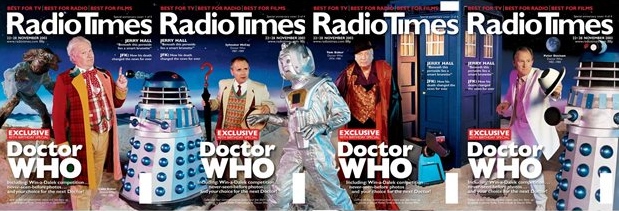
As is clear from the supporting Radio Times issues (with their inter-locking covers featuring the Fourth, Fifth, Sixth and Seventh Doctors), however, the popular memory of the series appeared to be based around nostalgia for the cancelled version of the programme, and hopes for Russell T. Davies’ new incarnation. Even in these covers, though, certain themes recur: notably a reliance on Multiple/Absent Doctors (the First, Second, Third and Eighth are absent) and references to shared narrative history (costumes, monsters, TARDIS)...
50th
Anniversary thoughts
As we approach the 50th anniversary special, scheduled for
Saturday 23rd November (and thus the first TV anniversary show since
Silver Nemesis to be broadcast without
any association with Children in Need),
it is unclear what (if anything) current showrunner and writer Steven Moffat
intends to draw from previous commemorations.
What is clear is that there is no longer one collective memory of the
show (if, indeed, there ever was). The 2013 anniversary special needs to target
different collective memories: post-2005 fans who might have only partial
knowledge of the preceding 40 years, long-term fans, and a general audience who
wouldn’t know who the Brigadier or UNIT was.
We are also in a situation where the anniversary special is being
executive produced by a fan for the first time. Pennebaker and Banasik (1997)
discuss the idea of a generational cycle of memory, where official
commemoration only happens after people in early adulthood have grown up, and
are now in positions to produce or influence media remembrances: that is
precisely the situation Moffat now finds himself in, which likely means he is
highly aware both of what previous anniversary shows have done, and what
themes/issues to avoid or tackle.
Based on this, what is the likelihood of the themes identified in the 10th,
20th, 25th, 30th and 40th returning
for the 50th? [SPOILER WARNING ON!]
Multiple / Absent
Doctors: There have already been brief appearances of old Doctors since Matt
Smith took over as the Doctor (and Moffat took over running the show): visual
appearances of all the faces in The
Eleventh Hour and Nightmare in Silver,
repurposed footage of Doctors and costumes in The Name of the Doctor. The BBC have already publicised the
involvement of David Tennant’s 10th Doctor, we now know that John
Hurt is playing a character called ‘The Doctor’, and there have been various
dismissals / comments from the other surviving actors.
Likelihood: aural appearances
highly likely, visual appearances less so (due to the obvious aging of many of
the actors, although Moffat partially got round this in Time Crash)
The Time Lords: Since the
programme’s return in 2005, the Time Lords have been largely absent, killed off
in a Time War (which has been referenced as recently as Journey to the Centre of the TARDIS but never shown on screen).
Likelihood: High,
particularly given the appearance of Hurt as a previously unknown / unseen
version of the Doctor
References to a shared
narrative past: fan favourite villains the shape-shifting Zygons have already been
teased, and it seems likely that a certain Silurian and Sontaran may appear.
Again, Moffat knows the value of the show’s iconography, so appearances by the
Daleks and the Cybermen seem likely. The show may also take a cue from Remembrance of the Daleks and revisit
narrative locations such as Coal Hill School, and it has been revealed that the
Brigadier’s daughter, and head of UNIT, will return (continuing the Lethbridge-Stewart
link through the 10th, 20th and 30th specials)
Likelihood: 100%, if only because that is usually the purpose of an anniversary special, to encapsulate what is best known/loved about a programme
Narrative change: The introduction
of the Hurt Doctor in The Name of the
Doctor has already potentially shifted the narrative of the whole
programme, and the announcement that Matt Smith will be leaving the show,
opening up the introduction of a Twelth Doctor, means that change is almost
inevitable. (this could also be seen as a pattern for the show: Jon Pertwee's final season started in 1973; Peter Davison's final season started in 1983...)
Likelihood: Guaranteed
Whatever else, it is clear from its specials that Doctor Who offers a different perspective on media remembrance than
the traditional journalistic/documentary celebrations. More often than not, Doctor Who’s anniversary specials are a
chance to celebrate and encapsulate central tenets of the programme’s history
(the Doctor, monsters, companions), to visually recreate specific elements of
that past (costumes, locations), or (since the 25th anniversary)
retouch and reinterpret that narrative and fictional past.
But, given Steven Moffat knows more about the previous anniversary
specials than most, perhaps November 2013 will offer up something new (rather
than something borrowed or blue)...
Monday 17 June 2013
50 Years in the TARDIS: Doctor Who's Anniversary Specials, Part 2

Ten years later, in 1983, the series revisited the anniversary special
in The Five Doctors, an episode that
sat outside of the normal run of the series (broadcast on November 23rd
as part of the Children in Need telethon): but this special had a more self-reflective
tone that can be linked not only to an increased audience for the programme (on
a global scale as much as a British one), the presence of but also a 1981 ‘Five Faces of Doctor Who’
series of summer repeats that included early adventures including The Three Doctors and which reasserted
certain notions about remembering the programme’s past: the stern grandfather
(Hartnell), the playful fool (Troughton), the action-man (Pertwee), the kooky
alien (Tom Baker); familiar monsters, faithful companions.
In The Five Doctors, a
mysterious figure retrieves each of the five Doctors (and a relevant companion)
from their own time-streams: so, the First Doctor is reunited with his
granddaughter Susan (Carole Ann Ford), the Second with the Brigadier (Nicholas
Courtney), the Third with Sarah Jane Smith (Elizabeth Sladen), etc. They are
all taken to an alien landscape (that the Doctors eventually recognise as the
Death Zone on Gallifrey), and forced to avoid familiar villainous adversaries
(a Dalek, Cybermen, a Yeti, the Master) while playing ‘the Game of Rassilon’.
Meanwhile, the Fifth Doctor (Peter Davison) tries to solve the mystery with the
High Council in the Citadel of Gallifrey.
As laid out, the narrative feels like a metaphor for writing an
anniversary storyline: the necessity of selecting each Doctor and companion
team, placing them in danger, relating that to a known monster. This
self-reflective quality is also clear in some of the dialogue and interactions:
Sarah Jane’s surprise that it is the Third Doctor she meets not the Fourth
(‘all teeth and curls’ is the Third Doctor’s comment), the familiar (from The Three Doctors) bickering between
Second and Third, the Brigadier’s comment ‘Splendid chap... all of them’ (a
deliberate echo of The Three Doctors’
‘Splendid chap... both of them’), and the interaction between Tegan (Janet
Fielding) and the Fifth Doctor about going on the run from his people in a
rickety old TARDIS: ‘why not, that’s how it all started’.
Like The Three Doctors there
is no referential sense of 20 years having past, or that there is such a
concept as 20 years or 1983 in the fictional world being displayed. Here, as in
1973, the passage of ‘real time’ is less important than the concept of
reuniting a series of known actors and characters. However, in other respects
the programme hews close to the themes introduced in The Three Doctors:
The multiple
Doctor / the ‘absent’ Doctor: As already noted, the programme brings together
five Doctors, although using six actors. After a brief clip of William
Hartnell, the role of the First Doctor is played by Richard Hurdnall; Troughton
and Pertwee return; and Davison continues to play the Fifth. Absent here (bar
some clips from the untelevised episode Shada)
is Fourth Doctor Tom Baker, who choose not to appear, having only been out of
the role for two years.

The Time Lords: Whereas Time Lord
hero Omega was the villain in The Three
Doctors, The Five Doctors offers
more glimpses of the Time Lord society by delving into its dark past, and the
figure of Time Lord founder Rassilon. Unlike The Three Doctors, which revealed unknown aspects of Time Lord
society and history, by the 20th anniversary there had been several
programmes devoted to Gallifrey, its people and customs, so the planet itself
was much more familiar. That also allowed writer Terrence Dicks to exploit
knowledge of President Borusa, previously a friend of the Doctor, and make him
the unseen villain of the piece. The figure of Rassilon hangs over most of the
story, but with some uncertainty over how positive he was, either encouraging
or stopping Gallifrey’s dark times.
References to a
shared narrative past: There are continual references to ‘old’ events: the
Second Doctor and the Brigadier talk about Cybermen and Omega, and are chased
by a Yeti; the First Doctor and Susan talk about the Dalek’s home planet,
Skaro; as noted, Sarah-Jane Smith talks about the facial difference between 3rd
and 4th Doctors.
Narrative change: Although The Five Doctors has less impact on the
wider series narrative than The Three
Doctors, it works to redefine and underline the programme’s central
concept: a Time Lord on the run from his own people, adrift in time and space.
It also appoints the Doctor to the position of President of Gallifrey,
something that is does return in the Colin Baker story The Trial of a Timelord.

Promoting the
Anniversary: Once again, the programme was
promoted through a special Radio Times cover,
a magazine, other media appearances (Blue
Peter, Pebble Mill), and a major BBC-organised convention in April 1983,
‘The Dr Who Celebration: Twenty Years of a Timelord’. Based at Longleat House
in Wiltshire, the convention was a huge success, with over 35,000 people
attending. Like the other promotional materials, the convention worked to
stress a particular remembrance of the programme that drew on monster costumes,
the showing old episodes, and appearances of the actors who had played the
companions, villains and the Doctors.
Remembrance of the Daleks (1988) and Silver
Nemesis (1988)
Only five years later, due to threats of cancellation, production
postponement and the replacement of Colin Baker, interest in a Doctor Who anniversary was at a lower
ebb and, despite several stories and events marking the programme’s silver
anniversary, the emphasis was back on ‘in-season’ celebrations closer to The Three Doctors than The Five Doctors. While all four stories
from season 25 can be described as commemorating the programme’s past in some
form, the two villain-centric stories offer the most obvious anniversary
elements.
Unlike previous anniversary programmes, both Remembrance of the Daleks and Silver
Nemesis use the idea of 25 years as a central narrative conceit: the former
taking place in 1963 (days or weeks after the Hartnell Doctor left), the latter
story taking place on 23rd November 1988, and built around a comet /
spaceship that revisits Earth every 25 years (because the Doctor got his
calculations wrong when it was launched). More self-referential than The Five Doctors, most notably through a
recreation (and repositioning) of the programme’s own fictional past (Remembrance revisits Coal Hill School
and – where Susan went to school in An
Unearthly Child and I.M. Foreman’s junk yard, where initial companions Ian
Chesterton (William Russell) and Barbara Wright (Jacqueline Hill) first
discover the TARDIS), neither story features the multiple or absent Doctor
approach of previous specials (although Hartnell’s Doctor is referred to by one
character), or old companions.

However, other tropes are present: no Time Lords are seen on screen, but
both stories revolve around their advanced technology (the ‘Hand of Omega’ (a
stellar manipulation device) in the Dalek story, and a living metal discovered
by the Time Lords in Silver Nemesis);
the episodes also feature the series’ most recognisable recurring monsters: the
Daleks (and their creator Davros) and the Cybermen; and both stories represent
attempts to shift the narrative direction of the show, making the Doctor into a
more active participant in his own drama, a Time Lord eager to manipulate the
future.
As such, the programme’s 25th year saw a reconstruction of
its own history (something that Steven Moffat’s current run has also attempted,
most notably in The Name of the Doctor,
the lead-in to the 50th anniversary special), setting up bridges
between the present, past and future of its fictional world, offering a new
framework for understanding the previous 25 years and repositioning the show
for its immediate future...
That future, however, was shorter than anyone knew...
Next
time: From Dimensions
in Time (1993) to Scream of the
Shalka (2003)... to 2013?
Tuesday 11 June 2013
50 Years in the TARDIS: Doctor Who's Anniversary Specials (Part 1)

[A] remembrance is... a reconstruction of the past achieved with data
borrowed from the present, a reconstruction prepared... by reconstructions of
earlier periods wherein past images had already been altered’ (Halbwachs 1952,
69)
Later this year, Doctor Who
will reach its 50th anniversary, a major milestone that few
television programmes have achieved. Although partially overshadowed by the
announcement that current 11th Doctor Matt Smith will be leaving
(and the now-traditional media interest in who will replace him), the 50th
anniversary will see a range of different celebrations, from a special episode
through a BBC-organised convention. As long-term fans of the programme know, however,
we have been here before: Doctor Who
celebrated its 10th, 20th, 25th and 30th
anniversaries with similarly well-anticipated television specials,
commemorative magazines and/or events. As each of those anniversaries has demonstrated,
the history of Doctor Who is in
almost constant revision, with reconstructions of narrative conceits and
alterations of past fictional events a de
rigeur feature of dramatic anniversary commemorations.
Over a series of three blog posts, I want to think about how Doctor Who’s anniversary celebrations have
set up recurring traits around anniversary television programmes. Specifically,
I want to think about how fictional celebrations such as The Three Doctors (1973), The
Five Doctors (1983), Remembrance of
the Daleks (1988), Silver Nemesis
(1988), Dimensions in Time (1993) and
Scream of the Shalka (2003) created
their own remembrances of the programme’s history – both in terms of narrative
(the fictional world of the Doctor, the TARDIS etc.) and behind-the-scenes
production information.
The media representation and commemoration of ‘real world’ historical events
(such as the Second World War) tends to take place through news and
documentary-led programmes, and such programmes manufacture their remembrances
through a combination of archive footage, dramatic recreation, voiceover, and (often
temporally disingenuous) editing patterns. These manufactured media histories, then,
renew, challenge and efface real memories, creating a collective public memory
of the original event – as I was writing this first blog, for example, it was
claimed that collective memory of the First World War has likely been shaped
more by Blackadder Goes Forth than
any textbook or documentary.
This, then, suggests the importance of media constructions to public
memory of ‘real world’ histories. Using Doctor
Who, however, these blog posts will explore how anniversary fictions can reproduce
and reassert particular elements of its fictional dramatic history, while
promotional materials support a particular mediation and representation of the
programme’s production history. By looking at these specific stories, it is
clear that anniversary dramas retell stories about their fictional pasts, adding
a new veneer of meaning in each retelling, and representing subtle shifts in
the collective memory through each recreation.
10th anniversary:
The Three Doctors (1973)
If you’ve read this far, I’m going to assume you have a basic sense of
what Doctor Who is: a time travel
drama aimed at family audiences, that was first broadcast on Saturday 23rd
November 1963, and grew in popularity due (at least in part) to the
introduction of the Daleks in December 1963.
The first major anniversary story is 1973s The Three Doctors, although a case could be made for ‘World’s End’,
the first episode of The Dalek Invasion
of Earth, given it was broadcast on 21st November 1964 and is
the end of the first major arc of the programme, reintroducing the hugely popular
Daleks (who had been killed off at the end of their first story) and ending
with the departure of the Doctor’s granddaughter Susan (Carole Ann Ford). Yet although
it falls around the right time of year, and features returning villains (subsequent
conceits of the anniversary episode), the story was not designed to commemorate
the programme’s one year anniversary.
The Three Doctors, however, was
produced as a deliberate attempt at commemoration, bringing together the First
(William Hartnell), Second (Patrick Troughton) and Third (Jon Pertwee) Doctors
to battle a Time Lord villain, Omega. The story is a solid example of Pertwee’s
era as the Doctor, a partly-Earthbound action-adventure romp, featuring most of
the regular supporting cast from UNIT (the United Nations Intelligence
Taskforce), a military force designed to combat the alien and unusual, led by
Brigadier Lethbridge-Stewart (Nicholas Courtney), and featuring Sergeant Benton
(John Levene) and Jo Grant (Katy Manning). This Earthbound focus was a
production conceit for budgetary and story reasons: the Doctor’s memories of
time travel taken away by the Time Lords and the TARDIS’s dematerialisation
circuit removed.
Unlike traditional ideas of media anniversaries, which are based around
the proximity to an actual date, The
Three Doctors was broadcast as the first story of the 10th
season of the show, with episode one debuting on 30th December 1972,
almost a year ahead of the anniversary. Most journalism-based media anniversary
programmes also make specific reference to the period of time that has passed:
but The Three Doctors has not
narrative reference to ten years having passed, or even that the adventure
takes place in 1973.
That said, several anniversary themes are established that recur through
future programmes:
The multiple Doctor
/ the ‘absent’ Doctor: the programme is built around the combination of
Hartnell, Troughton and Pertwee in both production and narrative terms. It is
the first time Doctor Who would
revisit its past in such an overt manner, but by no means the last; it was also
designed to be the first time all three Doctors shared screen space and time,
although due to illness Hartnell’s First Doctor is mostly ‘absent’ from the
reunion, delivering his lines via the TARDIS scanner. The Three Doctors also sets up the dramatic concept of rivalry and
competitiveness between the Doctor’s incarnations: the Second and Third Doctors
bicker throughout, while the First (who describes his ‘replacements’ as ‘a
dandy and clown’) acts as a drill sergeant in his cameos. Off-screen, the
Troughton-Pertwee relationship was cordial, but featured a clash of acting
styles, with Troughton more given to on-set improvisation.
The Time Lords: Ten years into
the programme, very little was known about the Doctor’s people, the Time Lords.
The Three Doctors establishes much
more information: Omega gave the Time Lords the power of time travel by
harnessing the power of a black hole; Omega is a hero on Gallifrey, the Time
Lord’s home; the Time Lords have a governing structure that includes a President
and a Chancellor; and there are ‘Laws of Time’ (the first of which is that Time
Lords should not meet their other incarnations)
References to a
shared narrative past: Anniversary programmes tend to be spaces where
particular views or perspectives on the past can be solidified: here, for
example, Benton and the Brigadier both recognise and reminisce about previous
adventures with the Second Doctor, most notably those involving villains such
as the Yeti and the Cybermen (in turn, these reconstruct a vision of Doctor Who that focuses on the
spectacular nature of the villains: something promotional materials such as the
10th anniversary magazine special would also focus on)
Narrative change: like The Dalek Invasion of Earth, The Three Doctors ends with a narrative
shift that affects the whole programme: the Time Lords return the Third
Doctor’s knowledge of time travel, and give him a new dematerialisation
circuit, allowing the programme to return to its earlier narrative structure of
off-world and Earth-bound adventures.
Promoting the
Anniversary: The Three Doctors was promoted with
features in the Radio Times, a
special celebratory magazine, appearances on Blue Peter and a special exhibition at the Science Museum in London
focus on the actors, crew, costumes and stories that defined the decade. Each
of these materials offered a stronger sense of the programme’s decade-long
success, the actors and crew involved, and the range of monsters the programme
was famous for. As such, these were more traditional media ‘anniversary’ celebrations,
pulling together strands from the previous ten years, rather than The Three Doctors’ narrative approach.
Next time: From The Five Doctors
(1983) to Silver Nemesis (1988)...
Thursday 20 December 2012
The Twelve Days of (Ealing) Christmas
A suitably festive contribution to round off my year (and a bit) of Ealing viewing - the blog will be back in 2013 with more musings on cinema and TV...
Nine Ladies Dancing
The top nine leading actresses include Googie Withers (6), Joan Greenwood (4), Moira Lister (4) Sally Anne Howes (4), Katie Johnson (4), Elizabeth Sellars (3), Kay Walsh (3), Adrienne Corri (2), and Patricia Roc (2). However, although never a lead, they are all beaten by Gladys Henson, who appeared in 10 Ealing films.
6 Six Googie Withers
The inestimable Googie Withers appeared in six Ealing films: she had a low-key start as the love interest for George Formby in Trouble Brewing (1939), before starring in some of Ealing’s strongest 1940s dramas: They Came to a City (1944), a supportive wife in Dead of Night (1945), a calculating Victorian femme fatale up against stern patriarch Mervyn Johns in Pink String and Sealing Wax (1945), a female farmer challenging tradition in The Loves of Joanna Godden (1947) and, perhaps her strongest performance, as Rose Sandigate in It Always Rains on Sunday (1947), struggling to reconcile her past life with criminal and her new domestic life in the East End of London.
Three French Locations
Many of Ealing’s films feature French protagonists, but three in particular use their French locations to set up a Britain-French narrative contrast: The Foreman Went to France (1942) strands its British hero in the middle of an invasion; David Farrar fakes his death before escaping back to Herbert Lom’s glamorous and sexualised Parisian club in Cage of Gold (1950); while Alec Guinness and Stanley Holloway engage in a madcap trip to Paris to retrieve their misplaced golden Eiffel Towers in The Lavender Hill Mob (1951).
Twelve Crichton’s Directing
Not counting his contribution to Dead of Night (1945), Charles Crichton directed twelve Ealing films, including comedy classics Hue & Cry (1947), The Lavender Hill Mob (1951) and The Titfield Thunderbolt (1953), as well as lesser known dramas like Dance Hall (1950) and The Man in the Sky (1957). Despite this, he still lags behind Basil Dearden (21 films) and Charles Frend (13), but ahead of Robert Hamer (7), Harry Watt (7), Walter Forde (6) and Alexander MacKendrick (5).
Eleven Pipers Piping
Before becoming famous for TV roles in Upstairs Downstairs and The Professionals, a young Gordon Jackson made eleven appearances in Ealing films, stretching from Tommy Trinder’s mate Alastair ‘Jock’ McFarlane in The Foreman Went to France (1942) to Peggy Cummins’ jealous boyfriend Ralph in The Love Lottery (1954). His distinctive brogue provided a Scottish perspective for war films, Australian epics and Victorian melodrama.
Ten Lads a Leaping
Aside from Gordon Jackson, the top ten leading actors who appeared in Ealing films include Mervyn Johns (12), Jack Warner (8), Jack Hawkins (6), Alec Guinness (6), Stanley Holloway (6), George Formby (5), Will Hay (5), John Mills (5), John Clements (5), and Raymond Huntley (4).Nine Ladies Dancing
The top nine leading actresses include Googie Withers (6), Joan Greenwood (4), Moira Lister (4) Sally Anne Howes (4), Katie Johnson (4), Elizabeth Sellars (3), Kay Walsh (3), Adrienne Corri (2), and Patricia Roc (2). However, although never a lead, they are all beaten by Gladys Henson, who appeared in 10 Ealing films.
Eight Alec Guinesses-a-killing
One of Ealing’s best known films, the dark comedy of Kind Hearts and Coronets (1949) is most famous for Alec Guinness’ appearance in eight different roles, as the members of the artistocratic D’Ascoyne family that Louis Mazzini (Dennis Price) kills off, one by one... Guinness would try and recreate the effect in Barnacle Bill (1958), but to less acclaim.
Seven Awards a Winning (kind of)
Ealing films were nominated for Academy Awards seven times, but T.E.B. Clarke proved victorious, winning ‘Best Original Screenplay’ in 1952 for The Lavender Hill Mob. The other six nominations were for:- 1949: Best Art Direction-Set Direction (Colour), Jim Morahan, William Kellner, Michael Relph, Saraband for Dead Lovers
- 1949: Best Original Screenplay, T.E.B. Clarke, Passport to Pimlico
- 1952: Best Actor, Alec Guinness, The Lavender Hill Mob
- 1952: Best Adapted Screenplay, John Dighton, Roger MacDougall, Alexander McKendrick, The Man in the White Suit (nominated) – from play of same name by MacDougall
- 1953: Best Adapted Screenplay, Eric Ambler, The Cruel Sea (nominated) – from Nicholas Monsarrat novel
- 1956: Best Original Screenplay, William Rose, The Ladykillers
6 Six Googie Withers
The inestimable Googie Withers appeared in six Ealing films: she had a low-key start as the love interest for George Formby in Trouble Brewing (1939), before starring in some of Ealing’s strongest 1940s dramas: They Came to a City (1944), a supportive wife in Dead of Night (1945), a calculating Victorian femme fatale up against stern patriarch Mervyn Johns in Pink String and Sealing Wax (1945), a female farmer challenging tradition in The Loves of Joanna Godden (1947) and, perhaps her strongest performance, as Rose Sandigate in It Always Rains on Sunday (1947), struggling to reconcile her past life with criminal and her new domestic life in the East End of London.
Five Aussie Things
Between 1945 and 1959, the head of Ealing Studios Sir Michael Balcon, followed through on his plans to develop and expand Australian film production, with The Overlanders, Ealing’s first film to utilise Australian stories, cast and location filming. Followed by Eureka Stockade (1949), Bitter Springs (1950), The Shiralee (1957) and Ealing Film’s swansong, The Siege of Pinchgut (1959), these films represent the more globally focused side of Ealing that looked (often eagerly) beyond Britain’s shores for stories and audiences.
Four Just Men (1939)
The fifth Ealing film under Michael Balcon’s stewardship of the studios, this confident and briskly paced crime-spy thriller lingers on some of the darker and dramatic strands of Ealing’s output, elements that would thread through later films as diverse as Went the Day Well? (1943), Dead of Night (1945), Against the Wind (1948), The Blue Lamp (1950), The Gentle Gunman (1952) and Nowhere to Go (1958).Three French Locations
Many of Ealing’s films feature French protagonists, but three in particular use their French locations to set up a Britain-French narrative contrast: The Foreman Went to France (1942) strands its British hero in the middle of an invasion; David Farrar fakes his death before escaping back to Herbert Lom’s glamorous and sexualised Parisian club in Cage of Gold (1950); while Alec Guinness and Stanley Holloway engage in a madcap trip to Paris to retrieve their misplaced golden Eiffel Towers in The Lavender Hill Mob (1951).
Two Audrey Hepburns
Before Roman Holiday (1952) and Sabrina (1954), Audrey Hepburn appeared in two very different Ealing films: a brief part as ‘Chiquita’ in the South American scenes that bookend The Lavender Hill Mob (1951), and a major role as Nora Brentano in spy drama Secret People (1952).
And a (solitary) Partridge in the Studio’s Pear Tree
Several stars made singular appearances in Ealing’s film output: Humphrey Bogart (The Love Lottery, 1954); Mai Zetterling (Frieda, 1947), David Niven (The Love Lottery, 1954); Harry Secombe (Davy, 1957), Simone Signoret (Against the Wind, 1948)and Benny Hill (Who Done It? 1956).
Wednesday 15 August 2012
The Great Ealing Film Challenge 95 (and FINAL): Passport to Pimlico (1949)
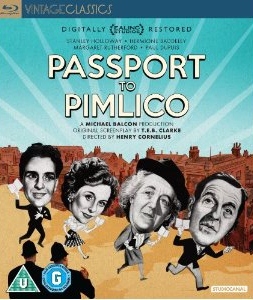 And so, it came to an end. Not with a whimper, but with a
bang: Passport to Pimlico, one of the
best known ‘Ealing comedies’, one of the films that (it is claimed) speaks for
the whole of the studio’s output and thematic interests, and one of the films
that first sparked my love of Ealing many years ago. It remains a film of its
time and place but, watching it during a time of British recession and
austerity, it is also a film that can still provide a satirical edge to events,
over sixty years on.
And so, it came to an end. Not with a whimper, but with a
bang: Passport to Pimlico, one of the
best known ‘Ealing comedies’, one of the films that (it is claimed) speaks for
the whole of the studio’s output and thematic interests, and one of the films
that first sparked my love of Ealing many years ago. It remains a film of its
time and place but, watching it during a time of British recession and
austerity, it is also a film that can still provide a satirical edge to events,
over sixty years on.
When an unexploded bomb (which is supposed to be the
final one in London, until another one is found: a small comment on the
fragility of fame/notoriety that echoes through the rest of the film) reveals a
hidden treasure trove, the inhabitants of Miramont Place, Pimlico discover the
land they live on is actually owned by the Duke of Burgundy. The local’s
realisation that they are now Burgundians (and not bound by British law) is a
beautifully structured piece of cinema that starts with the individual
realisation of bank manager Mr Wix (Raymond Huntley), which spreads through
other characters, ending up in a communal ‘knees up’ around the piano in the
local, a ripping up of ration booklets, and a rejection of traditional
authority figures. Because this is Ealing, such excesses are not without their
problems: as the bureaucracy of Whitehall rolls over them, Miramont Place
suffers from an influx of spivs and black marketeers, the imposition of strict border
controls and immigration, and the cessation of basic amenities (water,
electricity, food).
 One of the things that this Challenge has revealed is
that Ealing Studios was fascinated with the world beyond Britain’s borders:
whether that was expressed through literal border crossings in Johnny Frenchman (1945) or Against the Wind (1948), or completely
foreign-set narratives such as Saraband
for Dead Lovers (1948) or His
Excellency (1952). Here, the introduction to the film suggests a
continental or Latin setting, with salsa music playing, a fan turning: a
seemingly foreign location. That this turns out to be England in a heat-wave
(revealed through a camera shot that pulls back over Molly Reeve (Jane Hylton) sunbathing
on the roof, tilts down to reveal the fish shop beneath, pans across past the
pub door, and gazes down the street) is just one of the visual and thematic
misdirections that the film offers to its audience. It also points to the
inherently playful nature of this film, and of the studio more broadly.
One of the things that this Challenge has revealed is
that Ealing Studios was fascinated with the world beyond Britain’s borders:
whether that was expressed through literal border crossings in Johnny Frenchman (1945) or Against the Wind (1948), or completely
foreign-set narratives such as Saraband
for Dead Lovers (1948) or His
Excellency (1952). Here, the introduction to the film suggests a
continental or Latin setting, with salsa music playing, a fan turning: a
seemingly foreign location. That this turns out to be England in a heat-wave
(revealed through a camera shot that pulls back over Molly Reeve (Jane Hylton) sunbathing
on the roof, tilts down to reveal the fish shop beneath, pans across past the
pub door, and gazes down the street) is just one of the visual and thematic
misdirections that the film offers to its audience. It also points to the
inherently playful nature of this film, and of the studio more broadly.
The film moves along swiftly, developing new ideas
quickly and never stopping, a testament to the combined skills of director
Henry Cornelius, writer T.E.B. Clarke, director of photography Lionel Banes and
editor Michael Truman. Narrative details are referenced in passing, not shoehorned
in or signalled far in advance. The heat-wave, for example, is rarely mentioned
directly in dialogue, but is alluded to visually: in the opening few minutes,
we see Molly in a bikini; a few minutes later she slaps some fish into a
newspaper with a weather-related headline. The end of the heat-wave is also
narrated visually with a sudden rainstorm and mercury plummeting in a
thermometer. The skill of the pacing is also seen in the Whitehall scenes:
although featuring the star turn of Ministers Gregg (Basil Radford) and Straker
(Naunton Wayne), they are brisk and rapid, short digs at bureaucracy that don’t
overstay their welcome (unlike Gregg and Straker, who are slow and dogmatic).
The scene in the pub also quickly and succinctly develops
key characters: Wix’s rational approach, the more enthusiastic and communally
minded Arthur Pemberton (Stanley Holloway), and bossy Edie Randall (Hermione
Baddeley). The jealousy that Molly feels over Frank Huggins (John Slater) continually
trying to impress Shirley Pemberton (Barbara Murray) is expressed musically, as
Molly uses her singing to lure Frank’s attention away (the lyrics, ‘I don’t
want to set the world on fire, just start a fire in your heart’ reaffirm this)
It offers a strong example of the film’s focus on this community, but it also
stands as a marker for how efficient the script, editing and direction can be.
 As I suggested above, Pimlico
still feels relevant today: the austerity measures of post-war Britain fit well
with 2012 Britain, there is no money for public works (the Pemberton lido) only
private development (blocks of flats), and there is no escaping the circuitous
bureaucracy of Whitehall. In Miramont Place, public ownership of (and control
over) the banks, democratically elected people’s councils, and pulling together
is the response to such a crisis. Of course, that ignores the one fly in this
socialist ointment: the need for a feudal overlord, in this case the current
Duke of Burgundy (Paul Dupois). He may be charming, but he has little real role
to play in this film: that said, the sequence of him attempting to romance
Shirley under a night-time sky is beautifully undercut by the noises of a true
London street (cats howling, men gargling).
As I suggested above, Pimlico
still feels relevant today: the austerity measures of post-war Britain fit well
with 2012 Britain, there is no money for public works (the Pemberton lido) only
private development (blocks of flats), and there is no escaping the circuitous
bureaucracy of Whitehall. In Miramont Place, public ownership of (and control
over) the banks, democratically elected people’s councils, and pulling together
is the response to such a crisis. Of course, that ignores the one fly in this
socialist ointment: the need for a feudal overlord, in this case the current
Duke of Burgundy (Paul Dupois). He may be charming, but he has little real role
to play in this film: that said, the sequence of him attempting to romance
Shirley under a night-time sky is beautifully undercut by the noises of a true
London street (cats howling, men gargling).
With its strong location work, including shots in Piccadilly
Circus (where several Pimlico kids go to watch a Gaumont-British newsreel about
their street), the use of Whitehall, and the Underground (the scenes where the
Pimlico brigade stop the tube to check passports and to check food stocks is a
particular highlight), there is little doubt this is one of Ealing’s most
obviously ‘London’ films. But the comic treatment of more universal themes of
British community, identity (‘it’s because we are English that we’re sticking
up for our rights to be Burgundian’) and democracy (a sign reading ‘3% For, 3%
Against, 94% Don’t Know’ seems particularly apt to the film’s national vision)
shine through, and reassert the film’s claims to classic status within Ealing’s
95 films, and British cinema more generally.
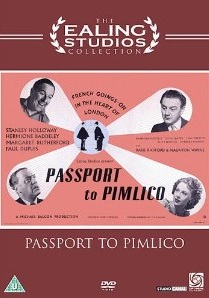
[Passport to
Pimlico is available on Blu-Ray and DVD from Studio Canal UK. See www.studiocanal.co.uk for more details]
Next time... some final thoughts on the Great Ealing Film Challenge...
Friday 10 August 2012
The Great Ealing Film Challenge 94: Nowhere to Go (1958)

Nowhere to Go was the second-last Ealing Film produced and, suitably, is also the second-last film to be viewed and written about for this Challenge. Erstwhile Ealing editor Seth Holt made his directorial debut in a crime thriller which he scripted with Ealing script editor (and theatre critic) Kenneth Tynan (from a book by Donald MacKenzie). The hiring and influence of Tynan is covered in more detail by Charles Barr in the new collection Ealing Revisited, but of the seven films Balcon produced after selling the physical studio in Ealing, this is often seen as the film that offered one potential (and unfulfilled) new route for Ealing Films in the late 1950s.
Canadian thief Paul Gregory (George Nader) pursues
Harriet P. Jefferson (Bessie Love) in order to steal her rare coin collection.
Having sold the coins, he puts the money in a safe deposit box and waits to be
arrested, expecting to be out in five years. Sentenced to ten years, and with
the help of Victor Sloane (Bernard Lee), Gregory breaks out of prison and plans
to collect the money, and leave the country. A series of accidents and
double-crosses sends Gregory spinning through London’s criminal underworld,
before he ends up on the run with socialite Bridget Howard (Maggie Smith)
through the Welsh countryside.
 There is a visual confidence on display in the film from
the opening images, underpinned with a jazz soundtrack (by Dizzy Reece), that
makes it feel like an early 1960s film rather than one from the late 1950s.
Given its interest in interior spaces, and cool London locations, the film
resembles later films like The Ipcress
File (1965) more than earlier Ealing crime thrillers The Blue Lamp (1950) or Pool
of London (1951). There is no dialogue in the first nine minutes of the
film, as Victor arrives at the prison, throws a rope over the wall, climbs in
and sets in motion Gregory’s escape; Gregory, in reverse, heads over the wall,
changes his clothes, and takes the car Victor left for him, before ending up in
a borrowed flat. It is a meticulous and well-staged sequence and, perhaps
because of Holt’s work as an editor, there is little excess fat here or,
indeed, elsewhere in the film.
There is a visual confidence on display in the film from
the opening images, underpinned with a jazz soundtrack (by Dizzy Reece), that
makes it feel like an early 1960s film rather than one from the late 1950s.
Given its interest in interior spaces, and cool London locations, the film
resembles later films like The Ipcress
File (1965) more than earlier Ealing crime thrillers The Blue Lamp (1950) or Pool
of London (1951). There is no dialogue in the first nine minutes of the
film, as Victor arrives at the prison, throws a rope over the wall, climbs in
and sets in motion Gregory’s escape; Gregory, in reverse, heads over the wall,
changes his clothes, and takes the car Victor left for him, before ending up in
a borrowed flat. It is a meticulous and well-staged sequence and, perhaps
because of Holt’s work as an editor, there is little excess fat here or,
indeed, elsewhere in the film.
Camerawork and set design remain strong throughout, with
composition in depth that sets up complex scenes that reward extra attention. The
apartment where Gregory stays for the first half of the film, for example, is a
precise and controlled environment: we see it shot almost exclusively from one
direction (a decision that could – unfairly – influence accusations of
theatricality), but this is a complex and deeply layered space, with layers of
information and narrative detail built on top of each other. Some images are
dominated by the white telephone that sits on a side table, or his bag: both act
as barriers to our ability to view the action, with Gregory often relegated to the
background of the room. Given this isn’t a space Gregory is familiar with, but
a borrowed location, it sets him adrift in a supposedly safe place: the idea of
lacking roots or a solid base recurs throughout. (Bridget’s apartment, by
contrast is a lived in space, more bohemian, with classic statues and arched
window frames).
Gregory is not the only character to be trapped or positioned
through such camera compositions: after being attacked, he lies unconscious on
the floor, his head taking up the bottom left of the foreground of the frame,
while Victor, in the deep background of the image, searches the apartment for
the money. In each case, the space of the apartment, and the arrangement of the
characters, is a bravura attempt to use location thematically. Forced
perspectives also crucially link character and event: Gregory in the background
of the coin dealers, with the bag (containing the coins) looming large in the
foreground; or an image outside Rosa’s flat, with a cat in extreme left of
image, and police cars pulling up in the mews below (the cat, disturbed, wakes
Gregory, who is able to escape across the roof). Some of these effects also suggest
generic identity: when Victor enters the apartment, the film uses canted camera
angles, and a streaming light from outside that casts diagonal venetian blind
shadows across the ceiling: both hark back to American (and British) crime films
and film noir from the past two
decades, an acknowledgement of how crime thrillers had changed since the 1940s.
 The narrative remains solid and well-paced throughout,
with Gregory running from club to apartment, to the apparent safety of
Bridget’s flat and, later, her family’s country house. Yet Bridget remains an
opaque character, a narrative prop as much as a strongly psychologised (or even
thematically useful) presence. Maggie Smith gives a solid performance,
suggesting an occasional wildness or ingénue quality (most obvious when talking
to Inspector Scott – Geoffrey Keen – in the final minutes of the film) but the
film fails to explain why Bridget would be attracted to, never mind help,
Gregory. She also appears at useful moments for the narrative (arriving at the
flat Gregory is staying in, within hours of him escaping from prison; leaving the
club that Gregory’s criminal connection runs) but these coincidences are
seemingly explained away by a line that she is a home for lost causes and lame
ducks: neither of which Gregory falls into, as a thief and murderer.
The narrative remains solid and well-paced throughout,
with Gregory running from club to apartment, to the apparent safety of
Bridget’s flat and, later, her family’s country house. Yet Bridget remains an
opaque character, a narrative prop as much as a strongly psychologised (or even
thematically useful) presence. Maggie Smith gives a solid performance,
suggesting an occasional wildness or ingénue quality (most obvious when talking
to Inspector Scott – Geoffrey Keen – in the final minutes of the film) but the
film fails to explain why Bridget would be attracted to, never mind help,
Gregory. She also appears at useful moments for the narrative (arriving at the
flat Gregory is staying in, within hours of him escaping from prison; leaving the
club that Gregory’s criminal connection runs) but these coincidences are
seemingly explained away by a line that she is a home for lost causes and lame
ducks: neither of which Gregory falls into, as a thief and murderer.
There is a claim here that the film is interesting
because it lacks the moral centre of previous Ealing productions, but is
Gregory any better / worse / different than psychotic Professor Marcus (Alec
Guinness, The Ladykillers, 1955),
Irish terrorist Matt Sullivan (Dirk Bogarde, The Gentle Gunman, 1952), or German spy Davis (Mervyn Johns, The Next of Kin, 1942)? Gregory is
ultimately punished – shot while committing the minor crime of stealing a
bicycle – but as his actions devolve from meticulous planning to kneejerk responses,
he becomes a less fascinating character, and Nader’s performance is largely
one-note. Most of the time he is surrounded by characters actors like Bernard
Lee or Maggie Smith who disguise the lack of personality in its star.
Nowhere to Go
opens with the shriek of a steam train as it rumbles past camera, and ends with
Bridget walking down the hill, with a cloudy sunset in the distance, jazz
drifting over the imagery. It is tempting to read more into those images than
Holt (and cinematographer Paul Beeson) intended. A sunset on Ealing Films,
perhaps, given their final film would be the Australian-set The Siege of Pinchgut (1959)? A shift
from the traditional (steam trains, moral certainty, metropolitan, jazz) to
regional British spaces that the British New Wave and rock ‘n roll would soon
begin to colonise? Ealing Films would never contribute to that version of
British cinema, but Nowhere to Go
suggests they might have had interesting things to add...
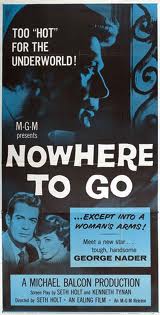
[Nowhere to Go
is not currently available on DVD from Studio Canal]
Next time, the Great Ealing Film Challenge finishes with one of the studios' best loved productions, Passport to Pimlico (1949)...
Subscribe to:
Posts (Atom)